Graphic Allegory
In the early modern period a print collection was conceived as the most complete compendium possible of the human world-view. Until the early 18th century its arrangement followed the depicted subject, until Pierre-Jean Mariette – curator of the collection of Prince Eugene of Savoy – turned to an alphabetical ordering by artist. Through Giacomo Conte Durazzo this path led to Adam Bartsch, whose work still forms the foundation of the scholarly study of prints. Yet these artistic-regional systems did not capture the purposes of printmaking.
Walter Koschatzky therefore divided printmaking, according to its societal role, into five groups:
Above these groups stand overarching elements – critique, caricature, satire and above all allegory. It is the least graspable member of any system: allegorical representation is an artistic rendering of the intellectual world of abstract concepts, bounded by emblematics and iconography. It adds one or more layers of meaning to every image and points to the hidden message. Three factors carried its career into the modern age: the secularisation of sacred subjects, the linking of ancient and Christian mythology, and the making-present of the themes.
In printmaking the enigmatic allegory is constrained by two traits: its manifold reproducibility, addressing a broad, anonymous public, and the frequent insertion of text – a quotation, a proverb or a verse composed for the occasion – that describes or explains the image.
Graphic allegory as Propaganda Fide
Its oldest field of use was religious instruction. With its naive expressive power the woodcut was an excellent medium even for the lower social strata; enriched with allegory (the Dance of Death, the parables of the New Testament) it acted as a social catalyst. From this circle almost all thematic categories emancipated themselves – essentially with the help of the nude body: biblical subjects such as Joseph’s chastity, Lot and his daughters, Susanna and the Elders or Adam and Eve rediscovered the human being as an autonomous aesthetic category. The confessional split of the later 16th century shifted subjects towards moral principles drawn from the Old Testament, forming a bridge of ideas between the camps.
Graphic allegory in the service of politics and power
One of the strongest impulses came from political propaganda. The first great commissioned art was created by artists under Dürer and Hans Burgkmair for Emperor Maximilian I – the Arch of Honour and the Triumphal Procession rank among the most ambitious projects of all time. Festivals, shaped by ephemeral architecture and allegorical floats, won printmaking its widest public resonance. Innsbruck witnessed a splendid example on 15 February 1580, at the wedding of Johann von Kolowrat and Katharina von Payrsberg: by commission of Archduke Ferdinand II, Sigmund Elsässer engraved 36 plates of the festival procession. The participants appeared as mythological heroes – Apollo, Ceres, Neptune, Hercules –, and the Archduke himself wore the mask of Jupiter, “a god of all gods”. Thus allegory placed the ruler close to divinity.
Graphic allegory as a work of art
The invention of engraving, with its precise, flowing lines, met the heightened aesthetic demands of the modern age; etching completed the triad of the “black arts”. An allegorical print that wishes to count “merely” as an autonomous work of art must forgo one of its essential components – the text – so that the viewer can judge it like a work of the other arts. Dürer’s Knight, Death and the Devil, the fearless pilgrim on the road of our destiny, is the prime example: an allegory of human existence entirely without words.
Graphic allegory as the grasping of human reality
In the service of the human mind a wide palette opens to allegory: the senses, the arts, the orders of cosmos and time. The scholar could illustrate his discoveries through allegorical personifications. Johannes Stradanus’s series Nova Reperta (newest inventions) places the discovery of America, the compass, alchemical distillation, clocks, spectacles, engraving and oil painting on a common plane of meaning – the glimpse into workshop and laboratory becomes, with the aid of text, a homage to the inventive human spirit.
Examples from the collection
Antonović selected a number of sheets from the volumes of German and Tyrolean artists and interpreted them iconographically and iconologically. A selection – each sheet carries its commentary on its catalogue page:
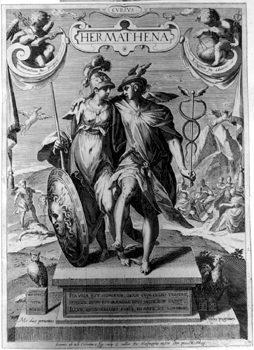 Hermathena — A. Sadeler after Hans von Aachen
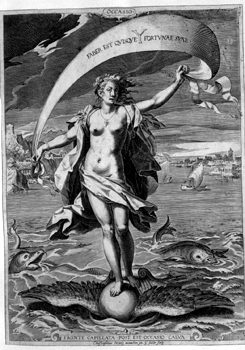 Occasio (Opportunity)
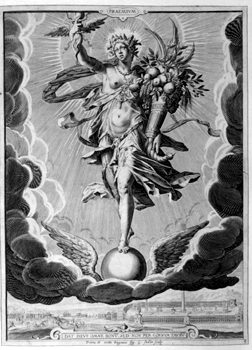 Praemium (The Reward)
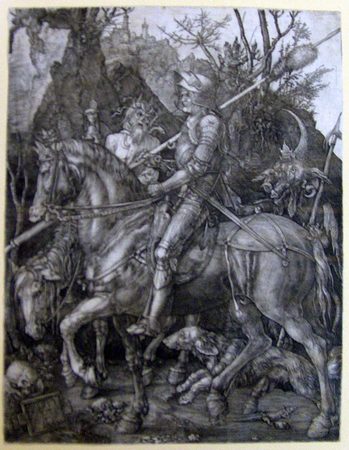 Dürer · Knight, Death and the Devil
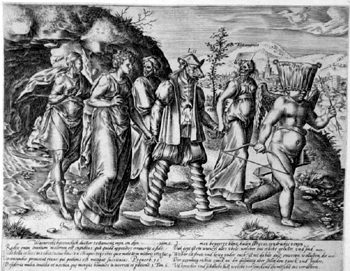 Litis Abusus · the procession of Strife
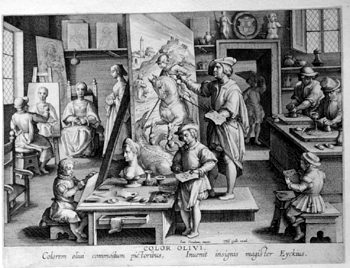 The workshop of Jan van Eyck
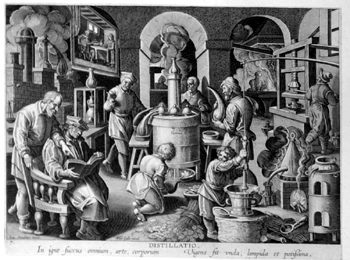 Distillatio (the alchemist’s kitchen)
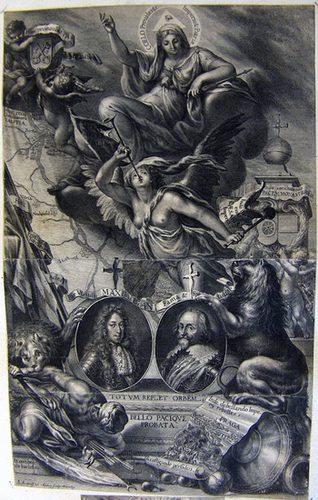 Homage to Bavaria
The full dissertation
This text summarises the study that underlies the entire cataloguing of the collection. The complete dissertation, with its scholarly catalogue and all illustrations, is available as a PDF: